The state of AI legal tech in Canada
How AI is reshaping legal research in Canada: the tool categories, the fabrication risk, and where a free bilingual bijural assistant fits.
Lire en françaisIn short: AI legal research in Canada now spans research assistants, drafting tools, practice management, and case-law databases with AI layers, and the biggest risk is that general chatbots fabricate cases. CourtStairs is a free-to-start, bilingual (English and fr-CA), bijural AI legal research assistant that answers questions in plain language and links every claim to a public Canadian source you can verify.
Ask a Canadian lawyer about AI legal research today and you will get one of two answers: quiet enthusiasm about hours saved, or a story about a colleague who filed a brief citing cases that did not exist. Both are true. AI is changing legal work in Canada faster than most professions adapt to anything, and the change is uneven, occasionally embarrassing, and, where the tools are built well, genuinely useful.
This is an attempt to survey the landscape plainly: what the tools actually do, where the real risks are, and what is still missing for a country that runs on two languages and two legal traditions.
What "AI legal tech" actually means
The phrase covers a wide range of products that have little in common beyond using large language models somewhere in the stack. It helps to break them into a few honest categories.
| Category | What it does | Typical user |
|---|---|---|
| Research assistants | Answer legal questions, summarize authorities, surface relevant law | Lawyers, students, self-represented individuals |
| Drafting tools | Generate or review contracts, clauses, and litigation documents | Transactional and litigation practices |
| Practice management | Automate intake, billing, scheduling, document handling | Firms of every size |
| Legal databases with AI layers | Add natural-language search and summaries over case law | Firms and libraries |
Some well-known names fit into one of these buckets. Certain tools focus on litigation and drafting; others on contract review; large legal publishers have added AI layers on top of their existing case-law databases; and the public database CanLII remains a foundational free source of Canadian law that many tools build on. I am deliberately describing these in broad strokes, because capabilities and pricing shift quickly and the category matters more than any single feature claim. The point is that "AI for law" is not one thing.
The honest problem: fabrication
The most important thing to understand about legal AI is also the least flattering. A general-purpose chatbot, asked for a case on a point of law, will often produce one, confidently, with a citation, a court, and a year. Sometimes the case is real. Sometimes it is a plausible fiction. Canadian courts have already dealt with filings built on invented authorities, and the professional consequences are not theoretical.
This is not a reason to avoid AI. It is a reason to insist on a specific property: the tool should show its sources, and those sources should be verifiable. A system that links every claim back to a public statute or a real decision turns the model from an oracle into a research assistant whose work you can check in a few clicks. A system that simply asserts is one you cannot trust with anything that matters.
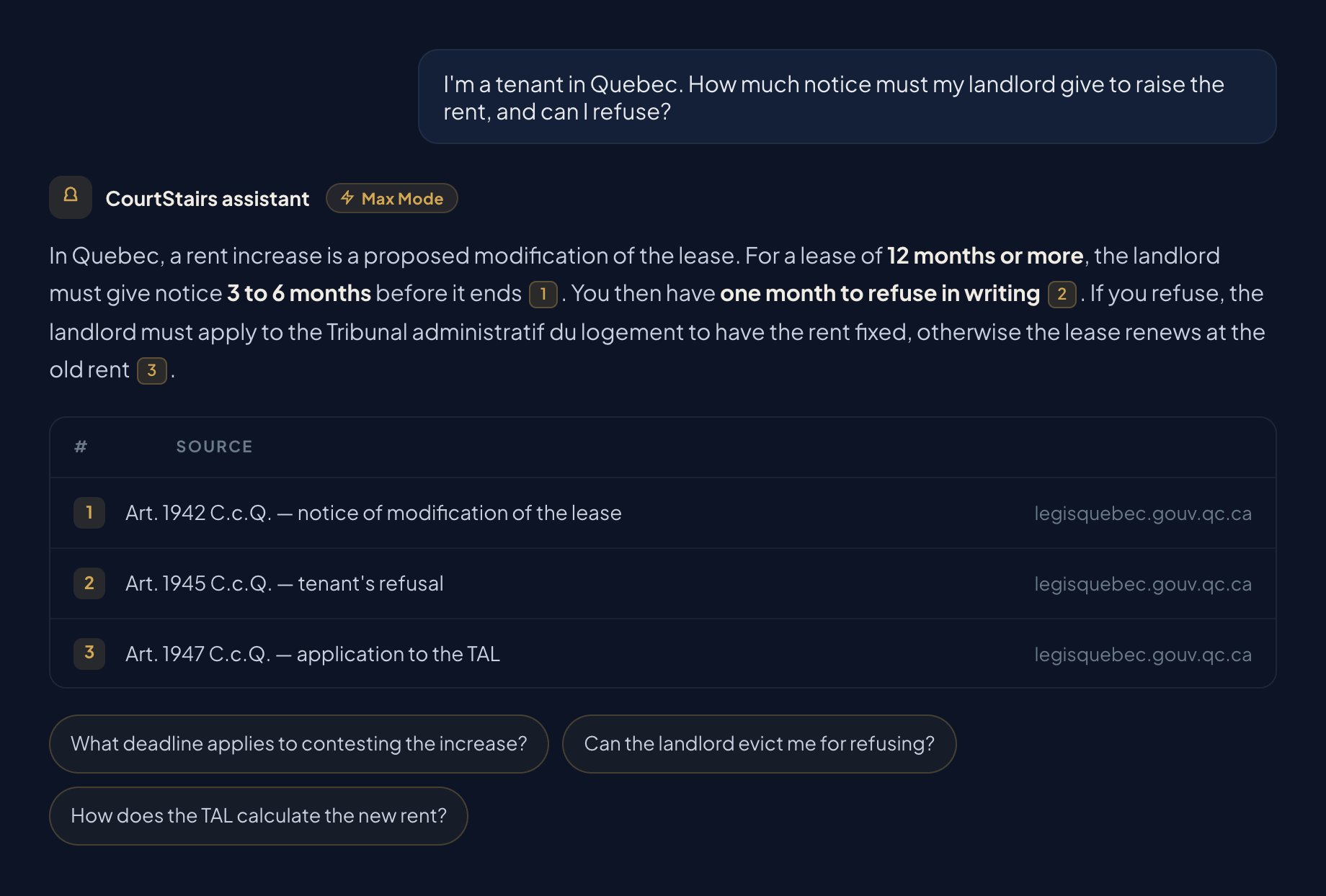
That distinction (cited and linked versus confidently asserted) is the single most useful lens for evaluating any legal AI product in Canada right now.
A general chatbot
- Can produce a case confidently with a citation, a court, and a year
- Sometimes real, sometimes a plausible fiction
- Asserts without showing its work, so you cannot check it
- Often built for the United States or common-law markets, excluding Quebec
Cited legal AI
- Links every claim back to a public statute or a real decision
- Lets you verify the answer in a few clicks
- Turns the model from an oracle into a research assistant whose work you can check
- Can be bijural, handling Quebec civil law alongside the common law
The two gaps nobody talks about
Beyond fabrication, Canada has two structural gaps that most legal AI, much of it designed for the United States or for common-law markets, quietly ignores.
The Quebec gap. Canada is a bijural country. Nine provinces and three territories run on common law; Quebec runs on civil law, governed by the Code civil du Québec and a distinct set of institutions: the Tribunal administratif du logement for housing, the CNESST for workplace matters, and much more. A great deal of legal AI simply excludes Quebec, because handling the Civil Code properly is harder than extending a common-law model one more province. For roughly a quarter of the country, that means the tools do not apply.
The language gap. Canada is officially bilingual, and in Quebec, French is not a translation layer. It is the language the law is written and argued in. Tools that treat French as an afterthought, or that answer French questions with machine-translated English reasoning, miss the point. Legal French is its own register, and fr-CA has its own vocabulary.
These are not edge cases. They are the daily reality for millions of people and the lawyers who serve them, and they are where a lot of otherwise capable tools fall short.
Where CourtStairs fits
I built CourtStairs to sit in the research-assistant category and to close those two gaps directly. The tagline is deliberately literal: cited answers, AI voice calls, and meeting analysis for Canadian law.
A few things make it different in ways that are factual rather than promotional:
- It cites its sources. Answers come in plain language and link back to public Canadian sources, so you can verify rather than trust.
- It is bijural. It handles Quebec civil law (the Code civil, the TAL, the CNESST) alongside the common law of the other provinces. Most tools exclude Quebec; this one treats it as first-class.
- It is bilingual. English and French (fr-CA) are both fully supported, with French as a first-class language rather than a translation of English output.
- It is free to start. There is a permanent free tier, open to anyone. Paid plans are per-seat and affordable, but you do not need a firm's budget, or a firm, to begin.
The product spans four surfaces. Chat gives cited answers to legal questions. Cases lets you build a case file and work through strategy with AI. Meetings turns an uploaded recording into a transcript, summary, and mind map. Calls lets you phone an AI legal assistant when typing is not practical.
The audience is deliberately broad. Lawyers and firms use it as a research and workflow tool; individuals, students, and self-represented litigants use it to understand where they stand before spending money on advice. Most legal AI is priced and marketed for large firms. Broad availability, meaning free to start, open to anyone, and across all of Canada, is a design choice, not a limitation.
What to look for, whichever tool you choose
If you take nothing else from this survey, take a short checklist. When you evaluate any AI legal tool in Canada, ask:
- Does it cite, and can I follow the citation to a real source?
- Does it cover the jurisdiction I actually work in, including Quebec, if that is where you are?
- Does it work in the language my matter is in?
- Can I try it without a procurement process or a large upfront commitment?
- Is it clear about what it is, meaning information, not a substitute for judgment?
A good tool answers all five comfortably. The technology is improving quickly, and the honest state of things in mid-2026 is that the best tools are already useful and the worst are already dangerous. The difference between them is not sophistication. It is whether they let you check their work.
CourtStairs gives you legal information, not legal advice. Every situation differs — speak to a lawyer about your own matter.