What CourtStairs does for lawyers vs. for individuals
How CourtStairs serves lawyers vs. individuals: research, drafting, and case strategy for lawyers, plain-language answers for everyone.
Lire en françaisIn short: CourtStairs is an AI legal research assistant for Canadian law that serves both practising lawyers and individuals in one product. Lawyers get deeper research with Max Mode, document drafting, case files with strategy tools (SWOT, evidence, win-probability), and meeting and call analysis, while individuals get plain-language, cited answers in Chat, with an optional Learning mode that explains the reasoning as it answers. It has a free tier (CA$0 for 15 credits and 2 minutes of voice per month), with paid plans starting at CA$49.99 per seat per month.
CourtStairs is an AI legal research assistant for Canadian law. The same product is used by a lawyer building a case file and by a tenant who just wants to know where they stand, which sometimes makes it hard to describe. This post separates the two: what the product does for a practising lawyer, and what it does for a regular person or student, using the same underlying tools.
One thing first. CourtStairs is a research tool, not a lawyer: it gives you legal information to act on, and it cites its sources so you can check them. It covers both Quebec civil law and common law (it is bijural) in English and Canadian French. What follows is a tour, not a pitch.
For individuals
- Chat as the main surface
- Plain-language answers with a citation table
- Learning mode explains the reasoning as it answers
- Free plan: 15 credits and 2 minutes of voice per month
For lawyers
- Chat, Cases, Meetings, and Calls
- Max Mode for deeper, wider search
- Case files with SWOT, evidence, and win-probability
- Draft mode plus the Microsoft Word add-in
For individuals and students
If you are not a lawyer, most of what you need lives in one place: Chat. You ask a question in plain language (for example, "how much notice does my landlord have to give before raising the rent?") and you get a written answer with a citation table showing the sources it relied on, web references, and a few suggested follow-up questions so you know what to ask next.
Two things make this usable for a non-lawyer rather than intimidating.
The first is Learning mode. It answers your question and explains the reasoning as it goes: what a term means, why one rule applies instead of another, instead of assuming you already speak the language of statutes. It is built for students and people without legal training, and it costs the same as a normal message.
The second is that the answer is cited. You are not asked to trust a paragraph on faith; you can see where each point comes from and follow it to the source. For someone deciding whether a problem is worth a lawyer's time, that is often the whole value: a grounded, readable answer to "do I actually have a case here?" without paying a consultation fee to find out.
Students get a second use out of the same tool, working through a doctrine or a line of cases with Learning mode on, and checking their understanding against the citations rather than a textbook's summary.
The Free plan exists for exactly this: 15 credits and 2 minutes of voice per month, at no cost. One credit is one message, so that is fifteen real questions before you decide whether to pay for more.
For lawyers and firms
For a practising lawyer, Chat is the front door, not the whole building. The work happens across four surfaces.
Chat is still where research starts, but a lawyer will reach for Max Mode more often: a deeper, wider search with stronger reasoning, for the questions where a fast answer is not good enough. It costs 2 credits instead of 1. And when the output is a document rather than an explanation, Draft mode produces it into a side-by-side canvas you can edit and export.
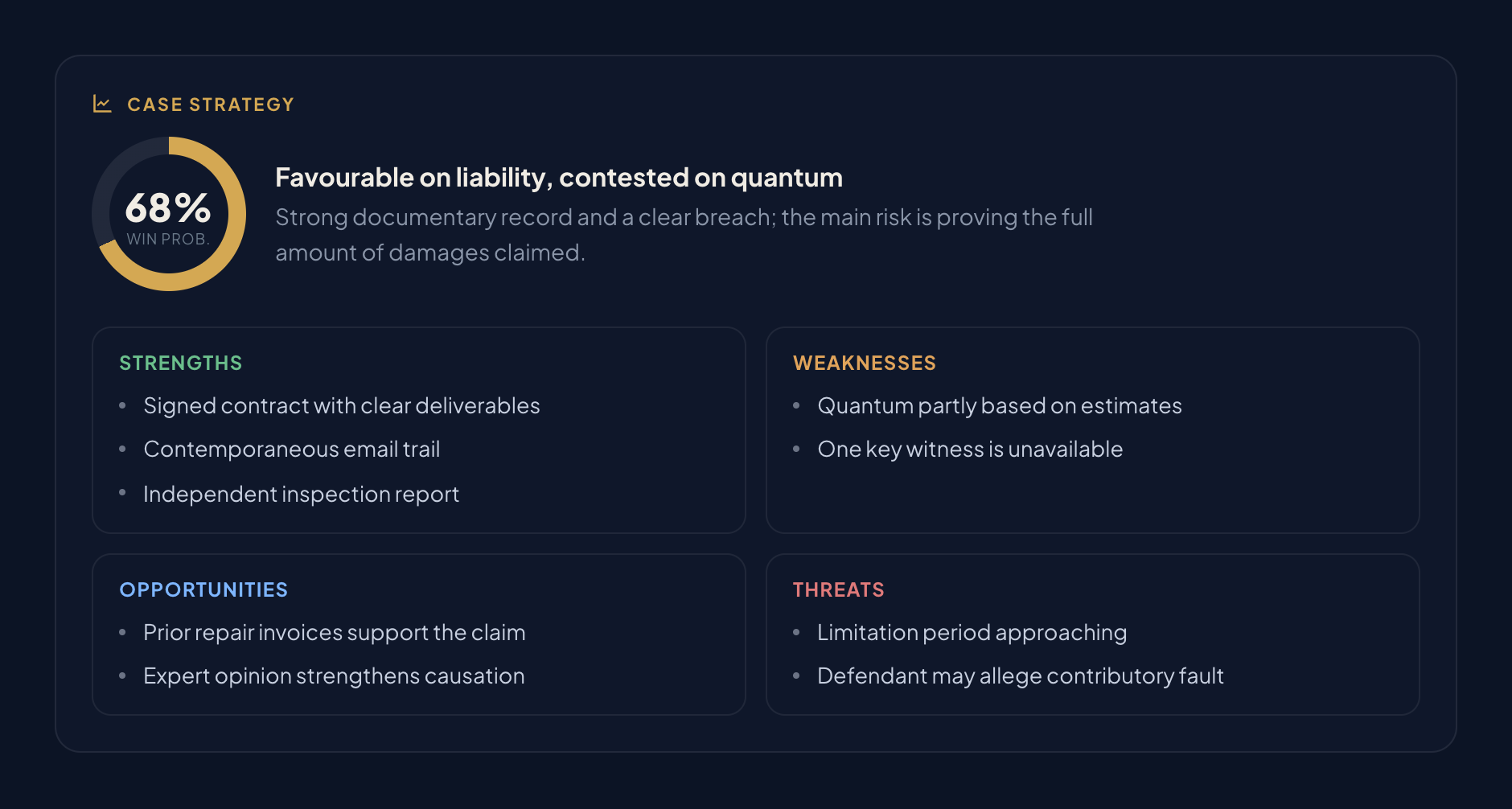
Cases is where a matter actually lives. A case file holds its documents and its chats in one place, and layers AI strategy on top: a SWOT analysis, an evidence view, similar cases, a mind map, a win-probability estimate, and a theory of the case. This is the part built specifically for how litigators think: not just answering questions, but pressure-testing a position before you commit to it.
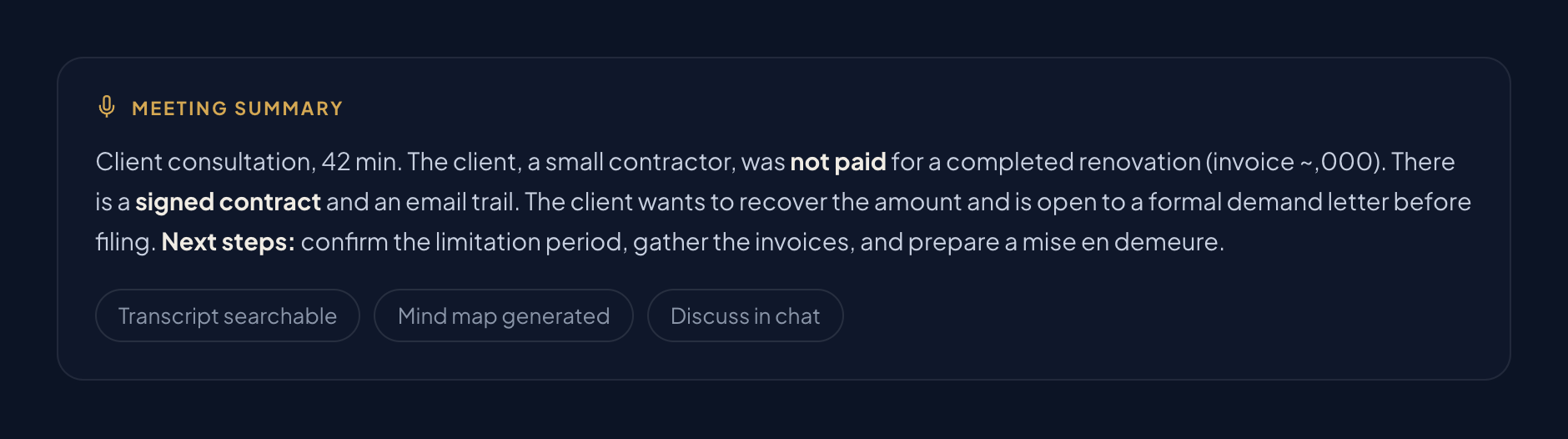
Meetings turns a recording into something searchable. Upload it and you get a transcription, an AI summary, and a mind map; you can search the transcript for a specific exchange and send any part of it straight into Chat with "discuss in chat", useful for client intake and witness prep where the exact wording matters.
Calls lets you phone an AI legal assistant and get answers grounded in Canadian law and your own research history. The call is recorded, transcribed, and summarized, so a question you asked while away from your desk does not vanish.
Around these, a few supporting tools: Gazette, a legal-news feed; My Documents, holding both generated drafts and official forms; and a Microsoft Word add-in so you can draft in place instead of copying text back and forth.
The same product, two ways of using it
The features do not change between the two audiences. What changes is which ones you lean on.
| Individuals & students | Lawyers & firms | |
|---|---|---|
| Main surface | Chat | Chat, Cases, Meetings, Calls |
| Typical answer mode | Learning (explains as it answers) | Max Mode (deeper search), Draft |
| Case strategy tools | Not usually needed | SWOT, evidence, similar cases, mind map, win probability, theory of the case |
| Meeting analysis | Not usually needed | Transcription, summary, transcript search, "discuss in chat" |
| Drafting | Occasional | Draft mode + Word add-in + My Documents |
| Typical plan | Free or Pro | Plus or Enterprise |
The tools underneath: modes, Cases, Meetings, Calls
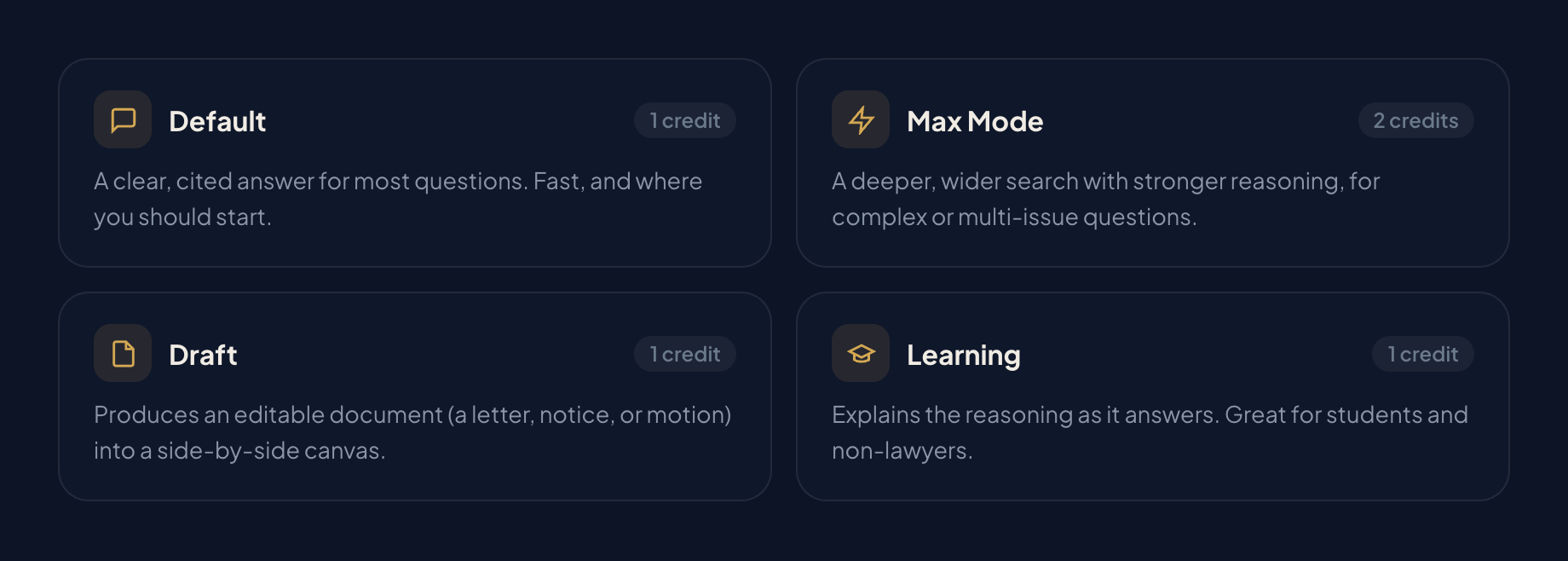
To make the surfaces above concrete, here is what the four answer modes in Chat do:
- Default: a standard cited answer. 1 credit.
- Max Mode: a deeper, wider search with stronger reasoning. 2 credits.
- Draft: produces a document into a side-by-side canvas you can edit and export. 1 credit.
- Learning: explains as it answers, for students and non-lawyers. 1 credit.
The four surfaces (Chat, Cases, Meetings, Calls) share the same research engine, so a citation you find in Chat, a document in a Case, and a transcript in Meetings all draw on the same grounding in Canadian law. That is the point of putting them in one product rather than four.
Pricing
Pricing is per seat, per month, in Canadian dollars. One credit is one message; Max Mode costs 2 credits.
| Plan | Price | Credits / month | Voice | For |
|---|---|---|---|---|
| Free | CA$0 | 15 | 2 min | Trying it out |
| Pro | CA$49.99 | 150 | 20 min | Students & individuals |
| Plus | CA$99.99 | 350 | 60 min | Daily legal research |
| Enterprise | Custom | Custom | Custom | Firms and teams |
If you run out of credits, top-up packs are available and never expire: 15 credits for CA$4.99, 35 for CA$9.99, and 75 for CA$19.99.
Which one are you?
If you have a single question and want a grounded, readable answer, start Free and turn on Learning mode. If you do legal research most days, Plus is built for the volume. And if you are a firm that wants case files, meeting analysis, and drafting in one place, that is what Cases, Meetings, and the Word add-in are for.
CourtStairs gives you legal information, not legal advice. Every situation differs — speak to a lawyer about your own matter.