How to get better answers from CourtStairs: chat, modes, and citations
A practical guide to asking good legal questions in CourtStairs: when to use Default, Max Mode, Draft, and Learning, and how to read citations.
Lire en françaisIn short: To get good answers from CourtStairs, ask a real question in plain language and include your province, what actually happened, and what you want to know. CourtStairs has four modes: Default gives a clear, cited answer for most questions (1 credit), Max Mode runs a deeper, wider search for complex or multi-issue questions (2 credits), Draft produces an editable document instead of a chat answer (1 credit), and Learning explains the reasoning as it answers (1 credit).
CourtStairs answers Canadian legal questions in plain language and cites where each answer came from. The quality of what you get back depends a lot on how you ask, and on which mode you use. This is a short guide to getting the most out of it.
Start with a real question, in plain language
You do not need legal keywords. Ask the way you would ask a knowledgeable friend, but include the facts that matter:
- Where you are. Law varies by province, so "in Quebec" or "in Ontario" changes the answer for tenancy, employment, limitation periods, and more.
- What actually happened. "My employer let me go after 9 years, no reason given" beats "wrongful dismissal."
- What you want to know. An amount? A deadline? Your options? Say so.
A weak prompt: "tenant rights". A strong one: "I'm a tenant in Quebec. My landlord wants to raise the rent by $150. How much notice do they need to give, and can I refuse?" The second gets you notice periods, the refusal window, and the governing Civil Code articles.
You can also ask in French. The whole product is bilingual, and a French question gets a French answer grounded in Quebec and Canadian law.
The four modes, and when to use each
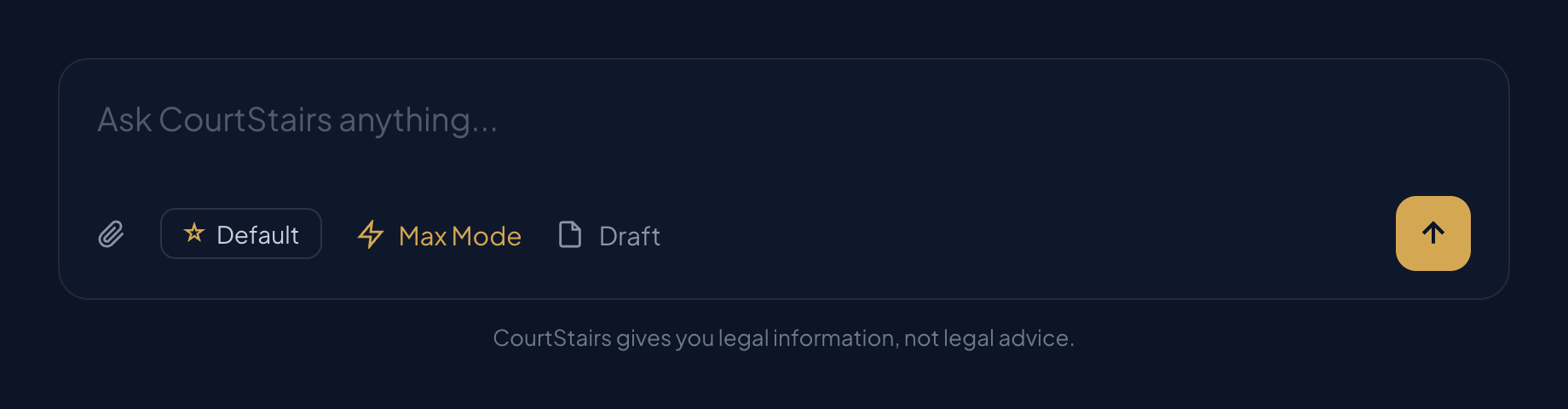
Above the message box you'll see a style selector and two toggles: Max Mode and Draft. Each changes what the assistant does. Here's when to reach for which.
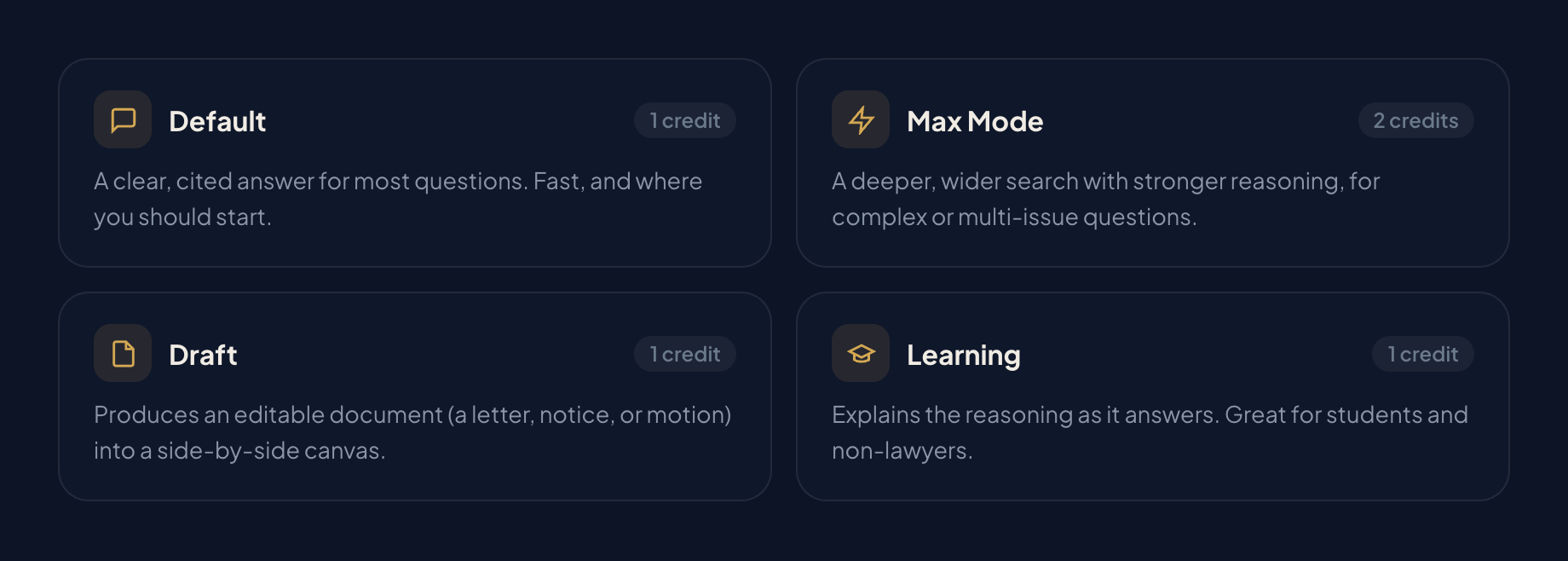
| Mode | Use it when | Cost |
|---|---|---|
| Default | Most questions, for a clear, cited answer. | 1 credit |
| Max Mode | The question is complex, multi-issue, or high-stakes and you want the deepest search. | 2 credits |
| Draft | You want a document produced, not an explanation. | 1 credit |
| Learning | You want the reasoning explained as it goes, great for students. | 1 credit |
Default
The everyday mode. Ask, and you get a plain-language answer with a citation table and, where relevant, web references. Start here for almost everything. It's fast and it costs a single credit.
Max Mode
Turn this on for the hard ones. Max Mode searches wider and deeper (more source documents, more web results, and stronger reasoning), which is what you want when a question has several moving parts. A good example: "My employer in Quebec terminated me without cause after 12 years. What are all my potential remedies under both the Act respecting labour standards and the Civil Code?" That question touches statutory notice, a recourse against dismissal, and reasonable notice under the Civil Code at once, exactly the kind of multi-issue prompt Max Mode is built for. It costs 2 credits because it does roughly twice the work.
Draft
When you don't want an explanation but a document, switch on Draft. Instead of answering in the chat, CourtStairs produces the document (a demand letter, a notice, a motion) into a canvas beside the conversation. You can edit it there and export it. If you use Microsoft Word, the CourtStairs Word add-in lets you draft in the same way inside a document you're already working on.
A useful pattern: research in Default first ("what must a formal demand letter for an unpaid invoice contain in Quebec?"), then switch to Draft and say "draft that letter". The draft is built on the research you just did.
Learning
Learning mode explains the law as it answers, rather than just stating the conclusion. If you're a student, or you want to actually understand why the answer is what it is, this is the mode. Same cost as Default.
How to read the citations
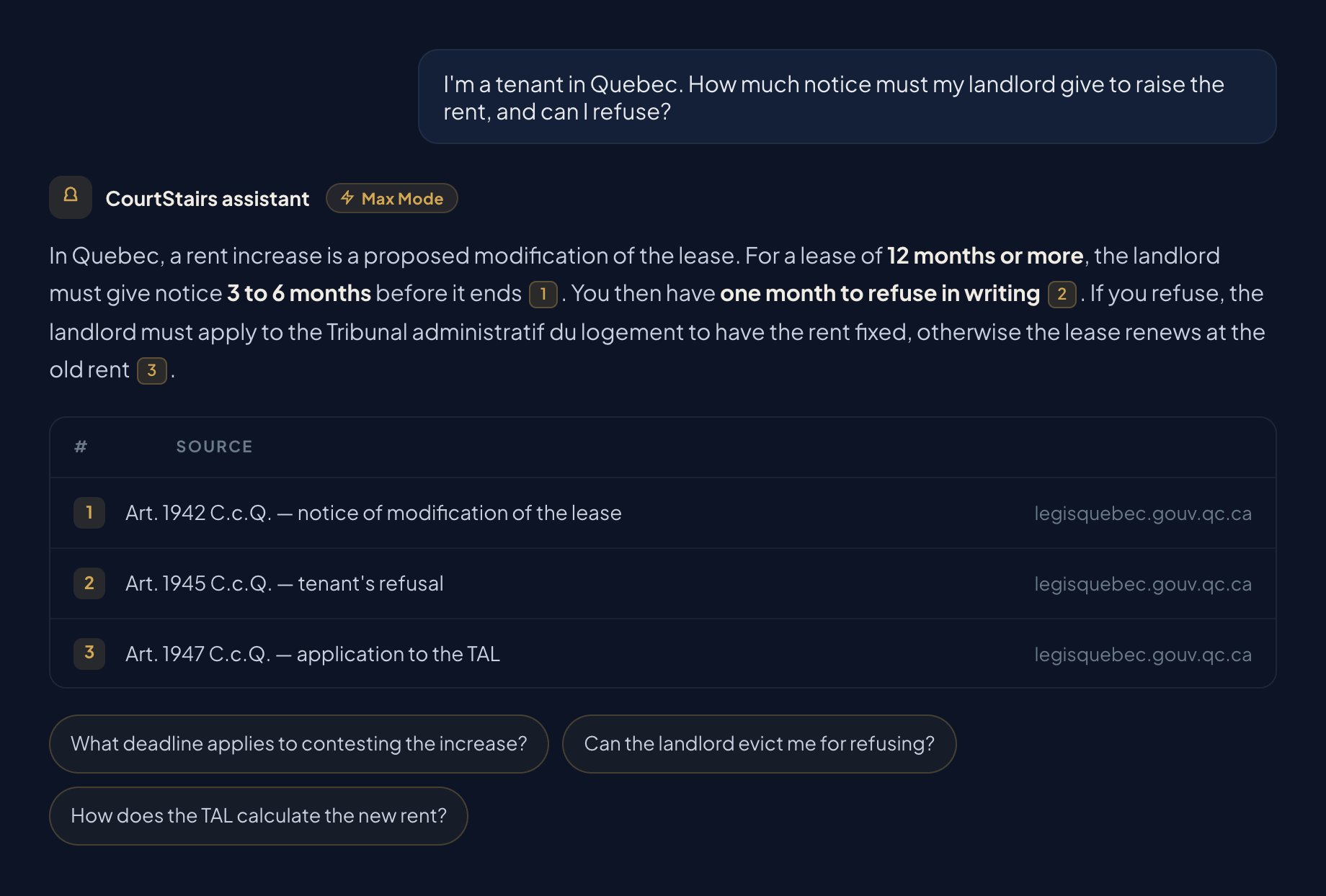
The point of CourtStairs is that you don't have to take the answer on faith. Every response is built to be checked:
- The citation table lists the authorities the answer rests on: statutes, regulations, or decisions.
- Web references show any external pages that were consulted, kept separate from the legal authorities.
- Follow-up chips suggest sharp next questions, so you can drill in without retyping context.
Treat the citations as the real product. If an answer matters, open the source and read the provision yourself. The assistant points you to it precisely so you can.
A few habits that pay off
- Give the province up front. It's the single biggest factor in getting the right answer.
- One matter per chat. Keep a chat focused on one question or file, and start a new chat for a new topic. Inside a case, the assistant already has your case context.
- Refine, don't restart. Use the follow-up chips or just reply, for example "what if the lease is month-to-month?", instead of re-explaining from scratch.
- Escalate deliberately. Start in Default, and move to Max Mode only when the question earns it. That keeps your credits for the questions that need the depth.
- Verify before you rely. Open the cited source for anything important.
Credits, briefly
Each message costs one credit, and Max Mode costs two. There's a free tier to try all of this, and if you run low, top-up credit packs never expire. You don't need to think about credits for ordinary use. Just know that Max Mode is the one that costs double, so save it for the questions that deserve it.
CourtStairs gives you legal information, not legal advice. Every situation differs — speak to a lawyer about your own matter.