How much notice must a Quebec landlord give to increase the rent?
Notice periods for a rent increase in Quebec, how long a tenant has to refuse, and what happens if they do, with the Civil Code articles that govern each step.
Lire en françaisIn short: In Quebec, a landlord must give notice of a rent increase within a set window before the lease ends: 3 to 6 months for a lease of 12 months or more, and 1 to 2 months for shorter or indeterminate leases (art. 1942 C.c.Q.). You have one month to refuse in writing, and if you do, the landlord must apply to the Tribunal administratif du logement to have the rent fixed, or the lease renews at the old rent. CourtStairs answers Quebec and Canadian legal questions like this in plain language, with citations to the Civil Code.
If you rent in Quebec, a rent increase is not something your landlord simply announces. It is a proposed modification of the lease, and the Civil Code sets out exactly how much warning you get, how long you have to say no, and who decides if you do.
The notice periods
The deadline depends on the type of lease. The landlord must send the notice within these windows before the lease ends:
| Lease type | Notice required |
|---|---|
| Fixed term of 12 months or more | 3 to 6 months before the end of the lease |
| Fixed term of less than 12 months | 1 to 2 months before the end of the lease |
| Indeterminate term (no end date) | 1 to 2 months before the change takes effect |
These come from art. 1942 C.c.Q., which treats a rent increase as a notice of modification. The notice must state the proposed new rent and the deadline you have to answer.
A notice sent too late does not shorten your rights. It simply does not take effect for that term.
You have one month to refuse
Once you receive the notice, you have one month to refuse it in writing (art. 1945 C.c.Q.). Three things follow from that:
- Refusing does not end your lease. You keep living there; your lease renews.
- Silence is acceptance. If you do nothing for a month, the new rent applies on renewal.
- You do not have to negotiate. A written refusal is enough.
What happens after you refuse
This is the part most tenants do not know, and it is the part that matters most.
If you refuse, the burden shifts to the landlord. They have one month from your refusal to apply to the Tribunal administratif du logement (TAL) to have the rent fixed (art. 1947 C.c.Q.). If they do not apply within that month, your lease renews at the old rent.
If they do apply, the TAL sets the rent using its own calculation method, based on the building's actual expenses (municipal and school taxes, insurance, energy, maintenance, and major work), not on what comparable units are charging.
- Landlord sends the noticeWithin the window above for your lease type, stating the proposed new rent (art. 1942 C.c.Q.).
- You have one month to refuseIn writing. Silence counts as acceptance, and the new rent applies on renewal (art. 1945 C.c.Q.).
- The landlord applies to the TALThey have one month from your refusal to ask the Tribunal to fix the rent (art. 1947 C.c.Q.).
- The outcomeIf they apply, the TAL sets the rent from the building's real expenses. If they do not, your lease renews at the old rent.
A note on commercial leases
None of the above applies to a commercial lease. The protective residential regime (the notice periods, the right of refusal, the TAL's jurisdiction) exists for housing. Commercial leases fall under freedom of contract and the general rules of lease (art. 1851 and following C.c.Q.), so the increase is whatever your lease says it is.
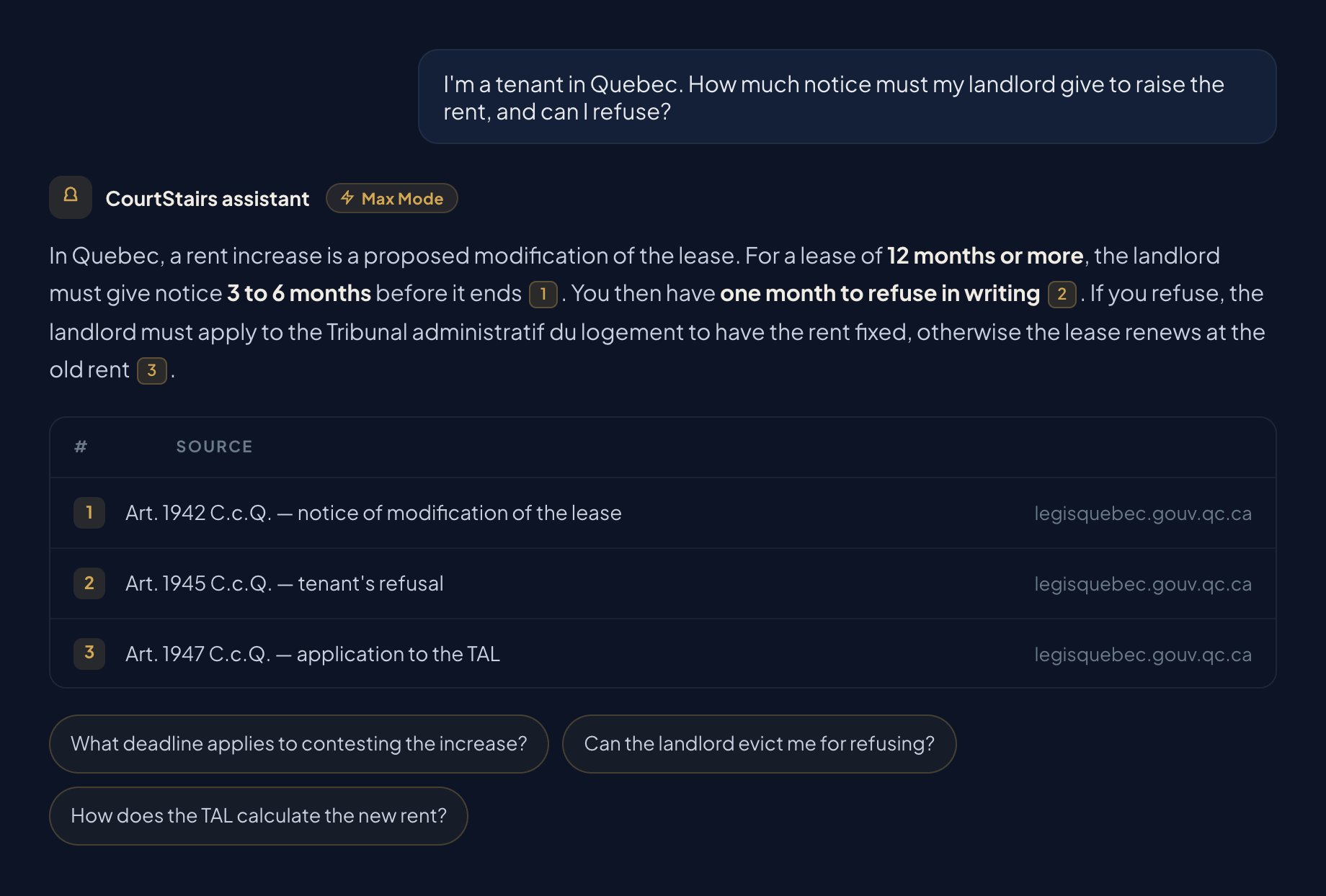
This is how CourtStairs answers a question like this: a plain-language explanation with each point linked to the Civil Code article it rests on.
What to do if you receive a notice
- Check the dates. Confirm the notice landed inside the window above for your lease type.
- Diarize the one-month deadline. It runs from receipt, not from the lease's end.
- Answer in writing if you are refusing, and keep proof of sending.
- Wait. After a refusal the next move belongs to the landlord, not to you.
Authorities cited
CourtStairs gives you legal information, not legal advice. Every situation differs — speak to a lawyer about your own matter.